Saturday, 28 January 2012


Tuesday, 24 January 2012


Monday, 6 June 2011
little bird in love in liverpool


Wednesday, 27 October 2010
e-detox

I've been racking my brain for some T. S. Eliot that talks about electronic detoxing, but strangely enough, he wasn't quite prescient enough for that. Oh but what am I saying? Of course he was...what else was he describing but the ghostly glow of the Mac screen (displaying Facebook) when he wrote
'only a flickr (haha)
over the strained, time-ridden faces
distracted from distraction by distraction
filled with fancies
and empty of meaning
tumid apathy with no concentration
men and bits of paper whirled by the cold wind
that blows before and after time'
Burnt Norton, III, Four Quartets
I did my first e-detox in early November last year, which happened to coincide (I later discovered) with an Observer article about how social networking, emailing and texting was 'fracturing our attention spans', reducing human contact and tyrannising our lives. Bit extreme maybe, especially as the article concludes:
‘Yoram Kalman sounds a cautionary note against using technology as a scapegoat. "Usually, if you look behind the technology, you find culture, social behaviour and you find people," says Kalman. "Technology is neutral, it depends what you use it for.”
So perhaps, in the end, most of us want to be tyrannised.’
I accept this is probably true of myself, but I was glad I’d made the conscious choice not to allow it to happen always.
The irony of blogging about electronic-detoxing is not lost on me (thanks Lewis!) but there's more to it this time, something that needs explaining before I go all quiet: this time I'm e-detoxing for little bird....
A lot of the last piece was about distance: distance in time – between who were and who we are now and distance in space – between us and home and the people we care about. My mum on the phone was sharing stories in real time, but from a place (Aberystwyth) it would take 3 hours 40 minutes to reach on the train from where I was dancing (Coventry). The stories and memories were from her youth, her University education, my childhood and our shared history. We were united across distance and time or a matrix of the two.
Much of the time, technology helps us transcend distance with such speed we tend to get seduced into thinking it somehow compensates for the absence of the people themselves. The speed at which we communicate makes a big difference, not least to our expectations of ‘gratification’ from contact with others. How is this affected when we communicate with more physical materials – by post – letters and parcels and objects that make a journey of their own – with their own untold story – to reach us? Something that takes more physical effort, forethought and care than pressing the send button. And what does it say, energetically, about where they travel from to converge again in one place? How does this map more tangibly than e-phemera (emails, texts) the web of interconnections of our geographical mobility, our social networks?
I will be asking 14 friends who I most often or only communicate with electronically – wordsmiths and dancers – to ‘participate’ in an exchange of materials through the post that will be brought together in the next performance of little bird, listening, weaving more stories into this developing narrative.


Sunday, 20 June 2010
Summer Solstice

Saturday, 5 June 2010
so said the little bird, listening in the tree


Wednesday, 2 June 2010
mission accomplished
Sunday, 23 May 2010
little bird listening by Jess Allen - Tues 1st June, 3-6.40pm

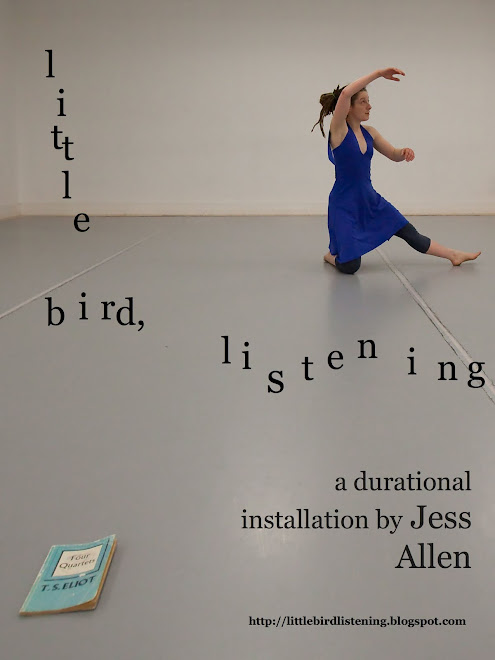
little bird, listening is a durational work exploring distance (in space and time) through endurance (of body and memory). It uses the rich and complex text of T. S. Eliot’s Four Quartets spoken continuously from memory whilst moving and performing tasks with objects. The words form a continuous sound score that is spoken in relay between the performer (live) and her mother (over mobile phone from Aberystwyth), for the length of the train journey that would reunite them (3 hours 40 minutes in Coventry).
Within this overarching structure, the work attempts to address how and where memory resides in the body-mind; how pre-occupation of the cortex with the conscious act of remembering text allows movement to arise from sub/unconscious; and how text – whether imagery or pattern – can become truly embodied through a regular practice of speaking-dancing.
The Quartets are perhaps the most famous twentieth century poems to deal with the nature of time but are also contained in the one slim volume that I mistakenly picked up age 6 and precociously read out loud to my mother; the book in which she once wrote my lessons in grammar and punctuation and the notes for her own mother’s epitaph. Now these words form the basis for this exchange,
So I find words I never thought to speak/In streets I never thought I should revisit/When I left my body on a distant shore
T. S Eliot | Little Gidding | Part II


Saturday, 22 May 2010


Between the live and the dead nettle...


Pigs Can fly or In the Rigging and the Aerial Part II


remaking the aerial piece TAKE; a dance in the park made last year on an outdoor rig...


